
On April 4, 2025, I had a coffee meeting in Chicago with Tracy Van Slyke who at the time was the Chief Strategy Officer at Pop Culture Collab. I got this meeting because I had run into her at a community event at SXSW, and about a year before that, I saw her speak on a panel at a community event in San Francisco. I was (am) a huge fan girl - her brain, her work on mobilizing fan communities for good - and it was thrilling to get to have a coffee with her.
I took pages of notes in that conversation and then had to run to the airport. And while my mind was a soup of ideas, I kept coming back to one of the first things she posed: What would it mean to build a field-led/field-owned narrative infrastructure where creators and community have leadership/ownership over the means of production, distribution and community formation? We were talking largely in the context of what the internet/digital spaces and technology can make possible.
It’s a huge question, thank goodness I wrote it down.
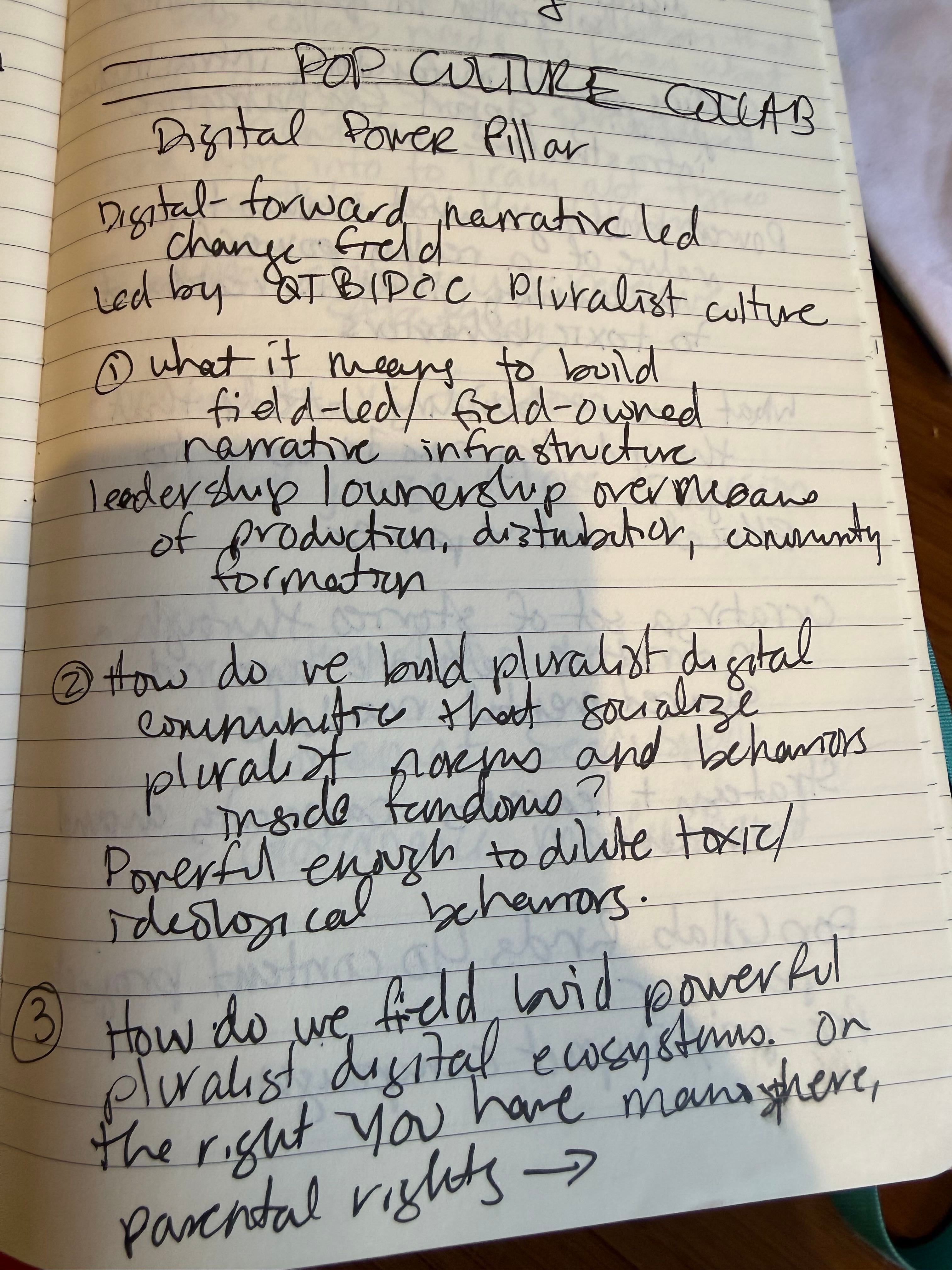
And what started percolating for me was a big swirling fear. It would seem to me that for the purposes of organizing communities, the conservative right has won the game. First because the people building technology have optimized for shareholder value and not citizenship, and manufactured outrage gets the most clicks and engagement. And second because trolling and abuse are features, not bugs, of the right’s online (and IRL) community strategy.
So if the entire digital ecosystem is literally built to tilt us all in one direction, how on earth can we as storytellers try to build a more connected and empathetic world inside of it?
I was sitting in Midway airport trying to work through this and I texted one of the smartest people I know, a man who has built an entire career around mobilizing fandoms and communities to turn their passion and care into action - largely through online engagement. I texted Ivan Askwith.
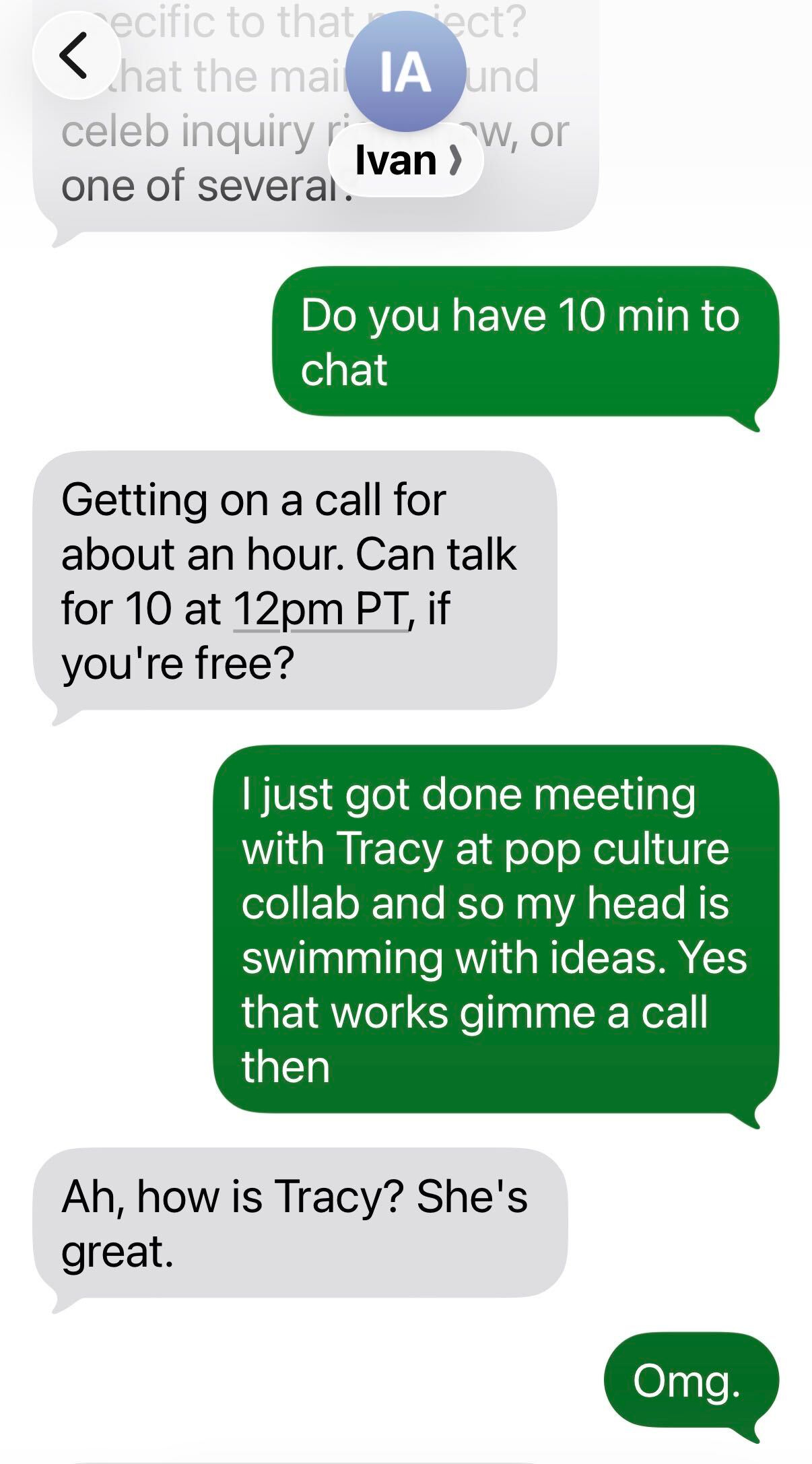
He called me and we talked for maybe 30 minutes. And in that time we surfaced something I have said perhaps thousands of times since then: we cannot expect the teams we built in the past to be the same teams that will deliver us new outcomes in this environment. We need to codify new roles - or elevate work that has been seen as marginal. It’s the slow, deliberate, messy work of truly galvanizing community. It is work that is largely misunderstood (what even is community, really?), overlooked (we need prestige PR first!), and undervalued (that’s just for niche things).
Ivan said that the way he always viewed his role was as a community producer, producing the community around the project as opposed to the project itself, and that there were probably a lot of people who played a similar role and didn’t have a title. At the end of the call, we agreed that we would like to elevate the role of Community Producer. And that we needed to talk to Tracy again together and find out if she could see what we were seeing.
Tracy was instantly as amazing partner.
Within just a few months, we had secured a rapid-response grant from Pop Culture Collab to develop the V1 of the Community Producer Playbook. Ivan, Tracy and I became a Core Team - originators of an idea with the passion and commitment to move it forward. Then we started reaching out to the experts we knew who could help us inform the playbook and also the broader practice, bringing them into the core team to powerfully shape the entire project.
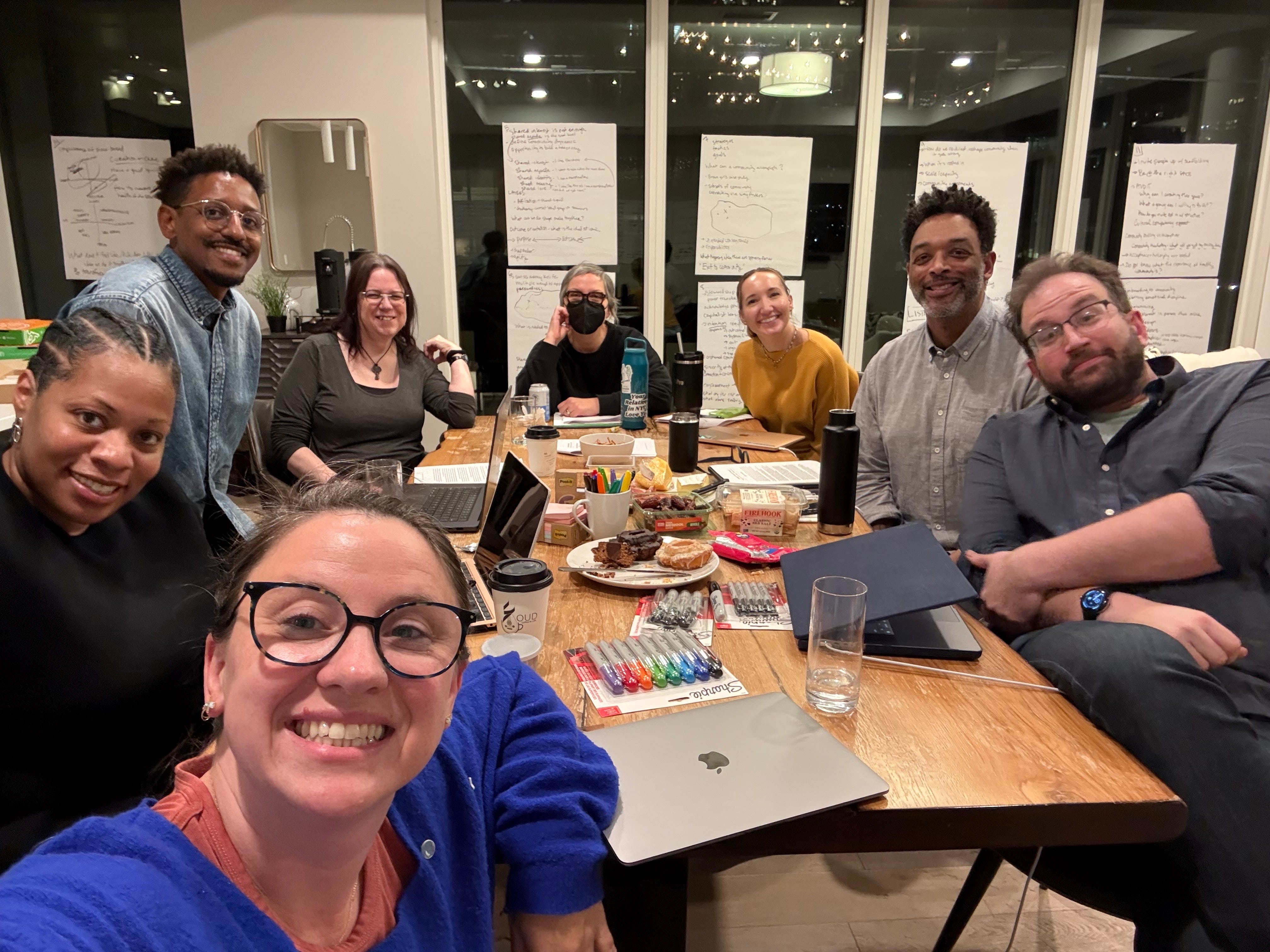
We gathered together in Chicago for two full days of engagement. We ate meals together so there was time for both structured and unstructured conversation. We broke up into groups. We covered the room in post-in notes. We developed an outline together.
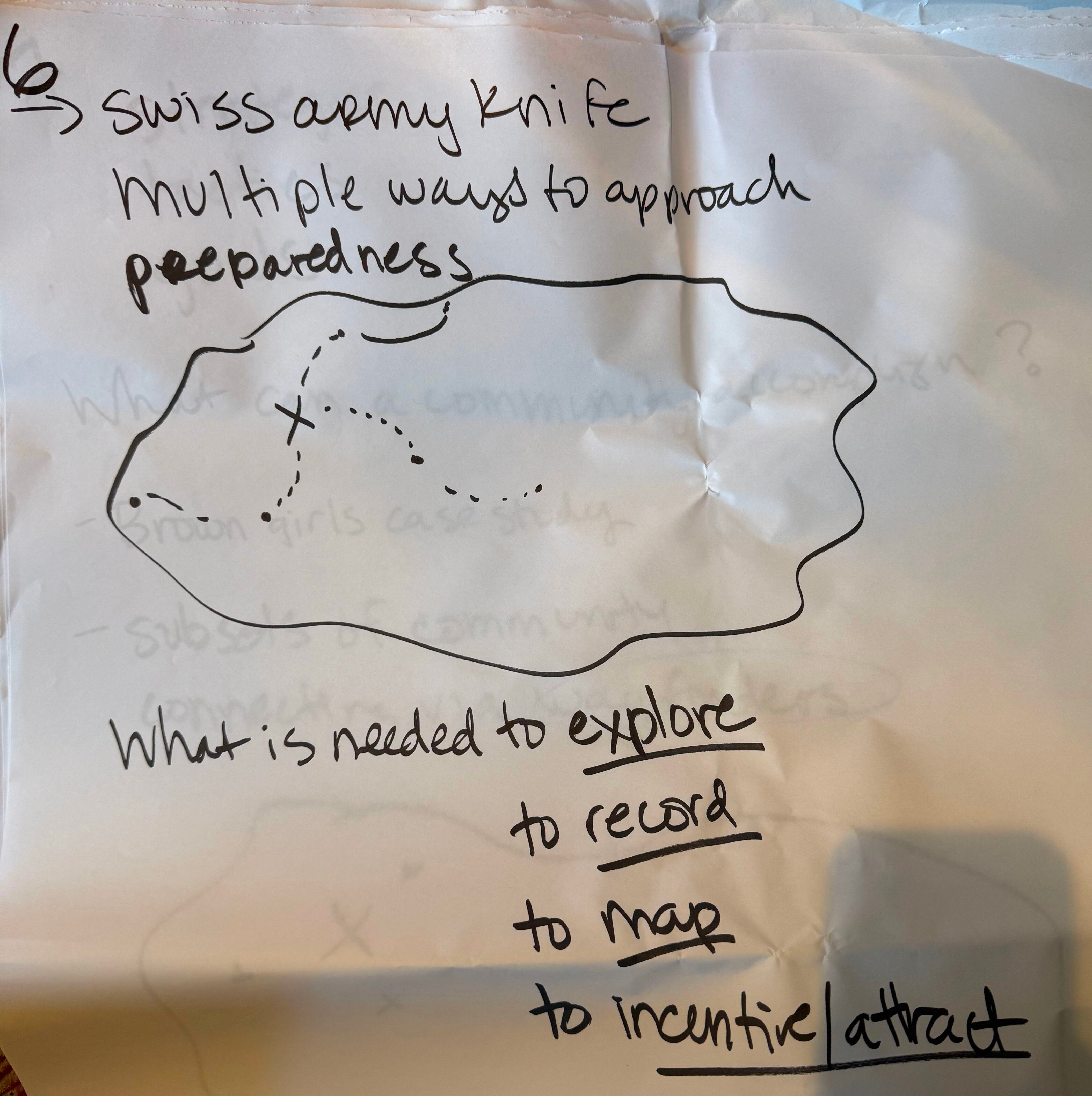
Our two days of work completed, Ivan and I left with the commitment to turn that outline into something legible, with the intention that like the Crowdfunding and Distribution Playbooks, this would become an open-culture resource where the community can submit feedback, corrections, case studies and examples.
Since then, we have met and engaged folks who have shifted and shaped the direction of this playbook. We have published excerpts on Substack and had some really spirited conversations that have helped us create sharper context around what this project seeks to do and whom it hopes to serve. People have gone so far as to read 150-page drafts and provide everything from deep content criticism to copy edits. Several of them pointed out entire sections that were glaringly missing (we’ve written them!). We assume (hope!) there will be more of this kind of engagement once we launch.
And just this past week we sent out the V1 draft to a wider circle whom I might still consider part of the “core team” - practitioners, advocates across media, activism and philanthropy - and they have already further honed the document. We implemented a form that collects the contact information of folks who already identify as Community Producers because one person pointed out that once people read the Playbook their first question might be: where do I find one?
Over time we hope to convene a cohort of people who would like to practice this work and resource them to collaborate with projects to build powerful case studies that continue to strengthen the foundations of a more equitable, field-owned narrative infrastructure.
This process has been a reminder that social media promises speed and scale, and community can provide depth and stability - but it can be slow, small, messy and you must be prepared to be in the muck. Both Ivan and I have had some of the most intense years of our lives - personally and professionally - and we have had to adapt, make space, hold boundaries, offer grace and tap other people in to get this Playbook to launch. So we’ve been in the muck, but not alone.
Today, knowing that we are going to release the V1 of the playbook next week, I pulled the original stack of large sticky notes from the Chicago meeting out from the back of my office closet and was reminded of some beautiful turns of phrase that came directly from the mouths of our collaborators. I went back through the Playbook draft and found places to include them.
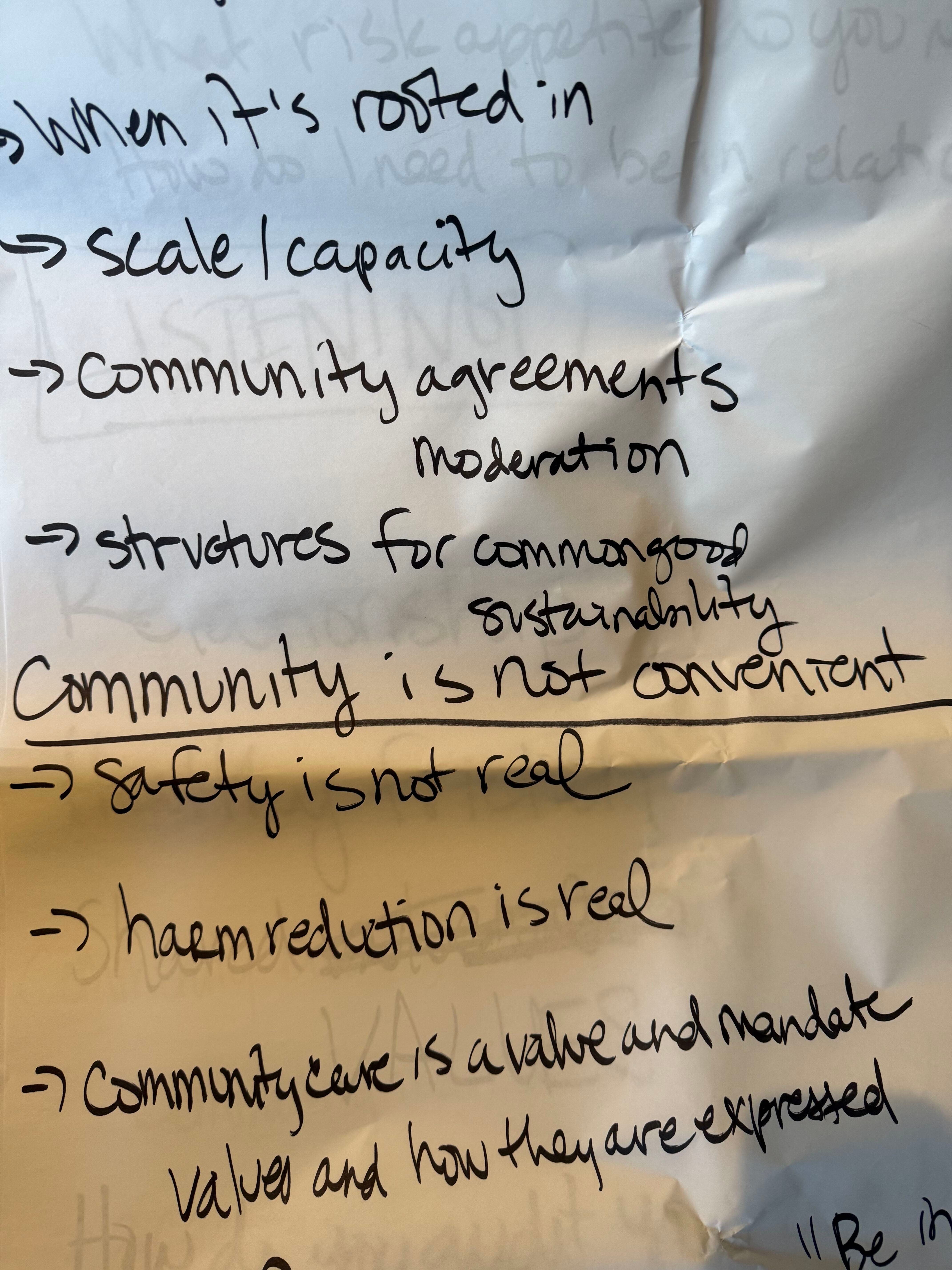
We hope your turns of phrase will soon be part of the Playbook, too!
UPDATE: The Community Producer Playbook is launched!
I love that as you continue grow, you see that new tools need to be created, and then you create them and make them public and free. THIS is central to the hacker ethos, "Information should be free."
That's my way of saying THNAK YOU (I'm shouting here). And also, "Please keep going. This matters. The work you are doing matters and makes the world better! (emphatic but not shouting)"