
The tools for our total independence as a filmmaking industry have really only existed for the last 10-15 years. Before that, critical parts of the funding, production and distribution processes lived on the other side of class divides, prohibitively expensive gear, and hard-to-reach gatekeepers. (And plenty of the filmmaking industry still lives on the other side of those barriers.)
Let’s be clear: it’s not that crowdfunding or DIY filmmaking didn’t exist (we have churches and public access TV as examples) but they operated as singular organisms floating out in the ether in closed-loop systems. Internet platforms started to popularize what were otherwise considered siloed community and creative behaviors, making them more accessible at scale. Pretty much everyone is now walking around with a 4K camera in their pocket. Millions of people have backed creative crowdfunding campaigns. And we have platforms that anyone can use to distribute.
But those platforms are not all created equal, and a lot of them are masking the top-down economics of consolidation behind the illusion of independence.

The same creators I hear raging against the Paramount-WB merger are also talking about figuring out their YouTube strategy. On the one hand, we can see clearly how corporate consolidation is actively bad for the middle class creator, but then middle class creators start building their brands on top of YouTube because it’s “where the audiences are.” They’ve even got us speaking the language of consolidation: very unspecific about who the audiences are (are they people or just numbers?) or what drives those audiences to do…anything. These platforms have us focused entirely on scale because only at massive scale can you hope to make a middle class living.
And there have been significant tradeoffs with the growth of these mega-platforms. We used to have dozens (hundreds?) of specialized distributors who were laser focused on one or two things that they excelled at. Many of those have been killed off by vertical integration, and it means a lot of films and audiences that used to have more bespoke means of connecting are all using the same platforms (social media etc) and tactics (social ads, “viral” campaigns) to reach audiences.
Google is one of a small number of tech companies that has amassed power far beyond what Paramount-WB could ever hope to have. Google owns so many user interfaces (email, search, AI) and so many sources of audience data and so many advertising intermediaries they’re typically getting paid 6-10 times inside of a single ad transaction. And they’re now growing even more power and influence in indie film by convincing creators that they’re where you go for your independence.
And that’s because they’re defining independence very narrowly. YouTube promises you a toolkit that makes it easy to upload and promote your content. They have the largest aggregate audience of any platform in the world! But you don’t own the audience, they do. You don’t have access to your audience’s email addresses or easeful ways to communicate with them. If you want to leave YouTube, you don’t have a way to take your audience with you - you just have to hope they follow. The amount of investment of your time, energy, effort and expertise it takes to build up a Youtube channel and following that leads to a sustainable career is already a disincentive to ever leave.
Youtube offers tools for monetization, but maintains total control over the rules and the ability to change them overnight. Videos that have been making money for days, months, even years can be de-monetized overnight with a change to the Terms of Service. Not to mention that Google is notorious for anti-competitive practices in the ad space. There are dozens of anti-trust judgements against them - here is one from 2025 that ruled they Google has been engaging in monopolist practices in the online ad space all the way back to the days its motto was “Don’t Be Evil.”
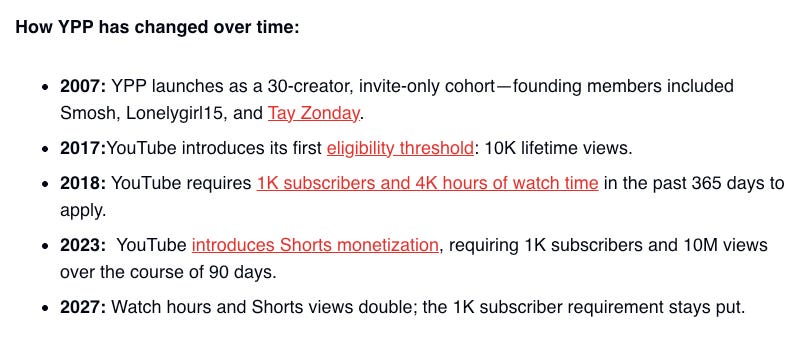
Youtube offers trickle-down-economics on steroids - Google will amass all this power and it will trickle down to you through services they provide but that they also monetize six ways from Sunday. As a publicly traded company, their revenue and their shareholders come first.
The problem we have right now is that we have let the most consolidated platforms set the metrics for how we measure our own success. It’s impossible to meaningfully monetize unless you reach massive scale, and so we keep feeding their machinery.
But artistic agency is about your taste and your goals defining the metrics of success. You don’t have to accept big tech infrastructure’s rules of the road. Your artistic vision can be what helps drive our entire industry forward. There are so many alternative platforms where the revenue split is so much more favorable to creators that it would take thousands - possibly millions - of views of your film on YouTube to return what you could make with one community screening.
And let’s be clear: reach does not actually mean impact. If you are trying to build an independent careers, having ten thousand emails is wildly more valuable to you than 1M views on any platform. Being able to gather 200 people in a theater in 5-10 cities is likelier to create on-the-ground impact than a social media account with 100,000 followers. They keep telling us everything is easier if we have those followers and those views, but then we spend all our time chasing those metrics instead of making our films and showing them to people on our terms with economics that benefit us.
Not each of us alone but all of us together.
This is where we could collectively decide to practice middle-out economics: instead of trying to get our slice of the pie, we grow the pie together by collectively building systems that create shared value.
The great thing is that we don’t need permission to practice this. We could decide today to invest our time collectively growing the platforms that on their own would never “compete” with Netflix, but that together could represent durable, sustainable and truly independent infrastructure. Platforms that become more valuable to all of us the more each of us leverages them, brings our audience to them. Platforms and tactics that don’t in turn enrich people actively destroying democracy, for example. We could gain back some of those specialized distributors and organizations we lost to consolidation.
If you’re new here, you may not know that I think we should be leaning hard into platforms like Kinema, OTV, Dropout, VideoStore.age, PBS, Watermelon+. I love what Moonbeem is doing for fan activation and revenue transparency.
If we want to truly own our own destiny as artists we will not do it alone. But we have to all agree that we want our artistic agency to extend to the fundamentals of our business. We cannot wait around for some big platform like YouTube to offer the solution. We have to decide what infrastructure we want and then to concentrate our efforts collectively on making it durable. Every filmmaker who wants this independent future must be willing to participate in building audiences and leading them to the platforms with unique experiences for audiences that also pay fair splits. We have to be the ones driving the strategy for our own distribution and creatively leveraging these platforms to demonstrate what is possible. We have to share what we learn, join together in campaigns, focus and combine our energy.
Waiting for someone else to do this lets them set the rules for how it gets done. Doing it alone is exhausting and scary. But if, instead of working alone to grow our parasocial followings on these massive platforms, we work together in solidarity to coalesce around a few independent platforms that create better economics, more distribution opportunities and just better vibes (!), we can evolve our industry. Like a bunch of single-celled organisms finding each other in the ocean and deciding we can work better together as one body - finding efficiencies, symbiosis and health together by investing in our collective good.
A big yes!